Blyskavka and Molniya converge on Obriy: What’s new in the Simulator’s latest update

A storm is gathering on the horizon. In the latest update to its UAV mission simulator, Twist Robotics added two new platforms: Blyskavka-1 (“Lightning” in Ukrainian), and a new hostile aerial target, Molniya-2 (“Lightning” in Russian).
The update expands the simulator’s capabilities in two key directions. On the one hand, it enables users to test the performance of the new twin-engine platform under varying combat payloads; on the other, it allows them to rehearse scenarios for the detection, tracking, and interception of aerial threats within Obriy Anti-Shahed. In addition, the new release places a strong emphasis on Obriy’s operational relevance, significantly enhancing the functionality and aerodynamics of both interceptor drones and aircraft.
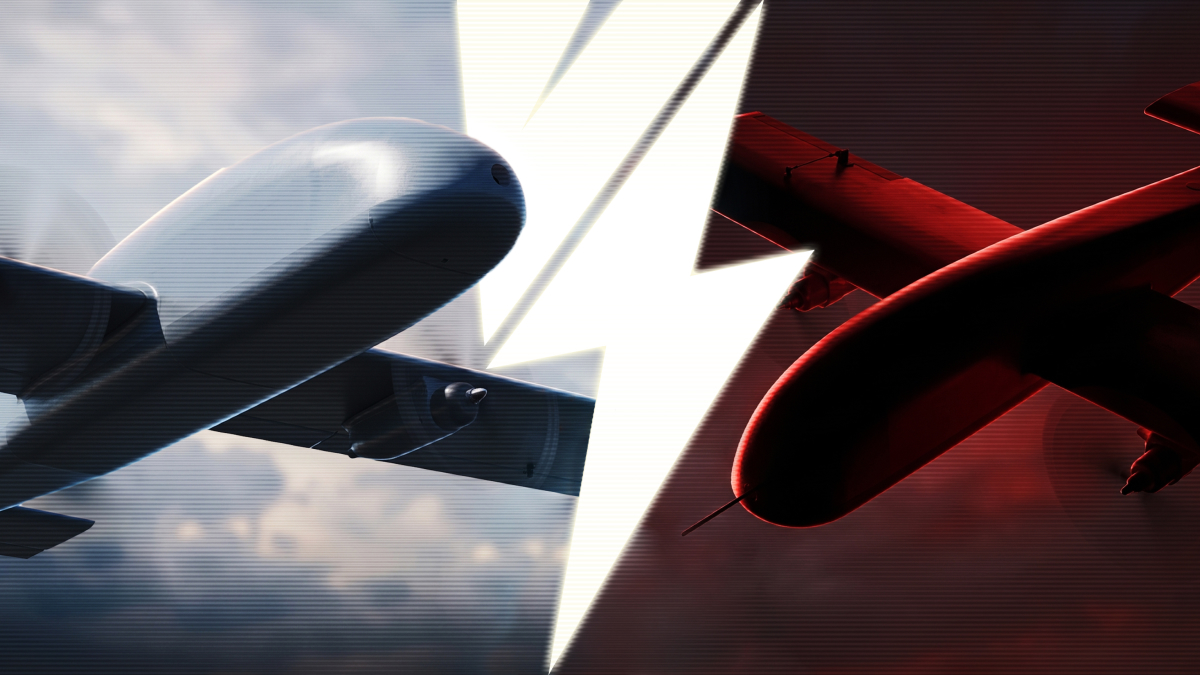
Blyskavka-1: Obriy’s First Twin-Engine Drone
One of the key additions to the simulator is Blyskavka-1, a new drone. It is the first twin-engine drone available in Obriy, bringing different flight dynamics, thrust distribution, and control requirements.
Blyskavka is a Ukrainian kamikaze drone developed following an analysis of the captured Russian Molniya. Like its Russian counterpart, it is designed as a low-cost strike platform, but has been adapted and improved to meet current operational requirements. The drone has already gained popularity among units of the Armed Forces of Ukraine as an affordable and practical platform for combat missions.
In real-world operations, Blyskavka-1 can carry a TM-62 munition. In Obriy, however, the drone delivers its best flight performance with either a 2.8 kg munition or a new 5 kg payload. This allows users to test the platform under different loads and observe how changes in weight affect its speed, stability, handling, and flight trajectory.
The drone’s minimum speed in the simulator is 70 km/h. For the operator, this means assessing the situation more quickly, planning the route more precisely, and developing a better feel for the platform’s inertia during flight.
Three control modes are available for training: Alt Hold, which maintains altitude; Angle, a stabilised flight mode; and Acro, a fully manual mode without automatic self-levelling.
Adding Blyskavka-1 to Obriy allows users not only to familiarise themselves with the new platform, but also to practise operating it under near-realistic conditions, with different combat payloads, speeds, control modes, and mission scenarios.
The update also introduces another drone: Deepstrike. This fictional model is designed for scenarios involving a heavier combat payload and higher flight speeds. In the simulator, Deepstrike carries a 9.5 kg TM-62 munition, flies at speeds starting from 120 km/h, and supports three control modes: Manual, Stabilize, and Cruise.
Molniya-2: A New Aerial Target in Obriy Anti-Shahed
The latest Obriy update introduces Molniya-2 as a new hostile aerial target for air-threat countermeasure scenarios.
Russian Molniya-type attack drones began to be widely used on the battlefield in 2024. These are simple, relatively inexpensive fixed-wing drones capable of operating at greater distances from the line of contact and striking logistics routes, rear positions, military equipment, and other targets. One of the most common variants is Molniya-2, an enlarged version whose characteristics make it a significant medium-range threat.
In Obriy, Molniya-2 is available in Obriy Anti-Shahed, a version of the simulator designed for practising the interception of aerial targets, including long-range Shahed-type drones.
Obriy Anti-Shahed features a radar module that simulates radar systems while accounting for the radio horizon. It generates target tracks on the tactical map and integrates with radar simulators, recreating the full cycle of short-range air defence operations—from detection and tracking to the decision to intercept.
The latest update makes engagement with aerial targets even more accurate. The simulator’s radar modelling has been improved to account for each target’s radar cross-section, a key factor that determines the range at which an airborne object can be detected. Scenarios can also include several radars at once, allowing users to simulate more complex airspace surveillance and control systems.
The interception logic has also been revised. Simply colliding with a hostile drone no longer causes it to explode or automatically disables it. To destroy the target, the interceptor must use an impact or proximity fuze. At the same time, a collision is likely to cause critical damage to the interceptor itself. This makes interception scenarios more realistic and better reflects the risks involved in real-world operations.
Thermal imaging has also been improved: Shahed-type drones can now be detected at a much greater distance. This expands the possibilities for locating targets at night or in conditions of reduced visibility.
More Accurate Detection, More Realistic Interception: What Else Has Changed in Obriy
In addition to Blyskavka-1 and Molniya-2, the update introduces several changes that make aerial target detection, tracking, and interception scenarios more accurate and closer to real-world conditions.
The simulator now also includes a MilELRS-type signals intelligence module, which can be enabled in the OSD settings. It consists of two components—a table and a detector—and is modelled using two omnidirectional antennas. The system filters out signals from the drone and its ground control station, allowing the operator to focus on detecting other RF emitters.
Alongside this, Obriy introduces a new hostile target: a ground station that can be located using the signals intelligence module. It is equipped with a directional antenna but, unlike an electronic warfare system, cannot interfere with control or video signals. This adds another type of mission to the simulator: not only intercepting aerial targets, but also searching for and detecting elements of the enemy’s command-and-control infrastructure.
A separate set of improvements focuses on flight dynamics. The update refines the behaviour of the existing SAKER Hunter and Middle Strike aircraft, as well as the VB-140 Blyskavka interceptor. Stall and spin mechanics have been improved, and the effects of wind on fixed-wing aircraft have been corrected.
The aerodynamic models of the Sting and Kraken interceptors have also been significantly improved. The VB-140 Blyskavka has received further upgrades, including new flight modes that expand training options for interception scenarios.
Together, these changes bring training closer to the realities of a combat mission—where success depends not only on speed and accuracy, but also on detecting a threat in time, assessing the situation correctly, making the right decision, and completing the mission successfully.
Obriy turns battlefield experience into scenarios where operators can make mistakes, learn, and improve before taking part in a real mission.
An advantage is built not only in the air, but also through training.
See you on the Obriy!